
News
World's first climate-positive car drive runs on e-methanol from Mannheim
On the historic Bertha Benz route from Mannheim to Wiesloch, three vehicles powered by Sub Zero Methanol removed CO₂ from the atmosphere with every kilometre — fuel produced at the Mannheim wastewater treatment plant with ICODOS technology.
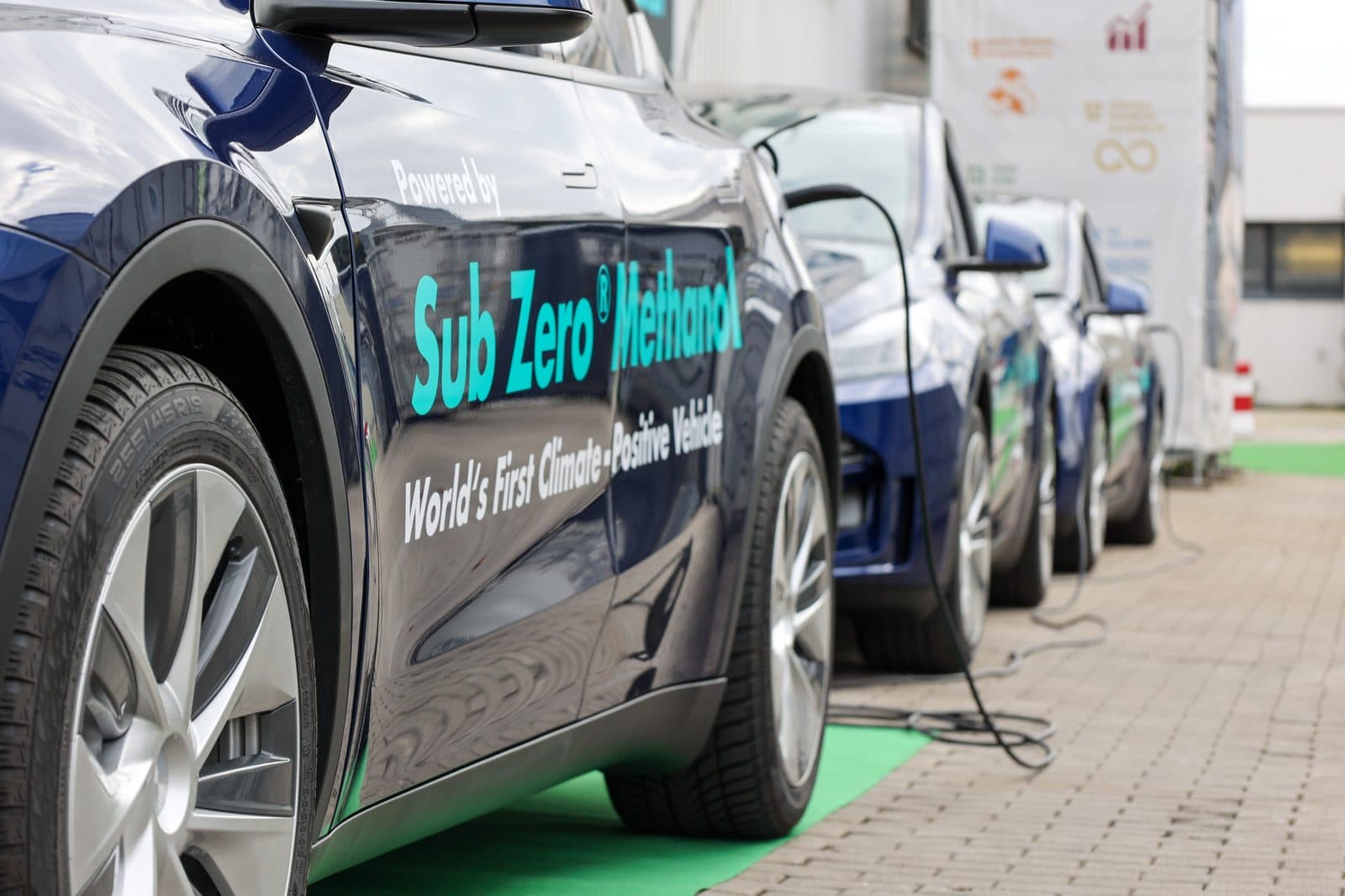
Mannheim/Wiesloch, 15 October 2025 — On 14 October 2025, the first climate-positive car drive in history took place on the route from Mannheim to Wiesloch — the same legendary stretch on which Bertha Benz wrote automotive history in 1888. Three HyperHybrid vehicles of the OBRIST Group, running on Sub Zero Methanol, demonstrated that mobility can be designed not just climate-neutral but climate-positive: every kilometre driven actively removed CO₂ from the atmosphere, with three kilograms of carbon captured in total.
The fuel: produced at the Mannheim wastewater treatment plant
The demonstration was made possible by a technology partnership between the OBRIST Group, ICODOS, the Karlsruhe Institute of Technology (KIT) and UP Catalyst, who together realised the world's first Sub Zero Methanol demonstration plant at the Mannheim wastewater treatment plant. There, green methanol is produced from atmospheric and biological CO₂ — a fuel that is not merely emission-free in use, but net CO₂-negative across its cycle.
From the world's first filling station to climate-positive driving
The symbolism of the route was deliberate: in 1888, Bertha Benz refuelled her Patent-Motorwagen with ligroin from the Stadt-Apotheke in Wiesloch — the world's first filling station. 137 years later, the journey stood once again for progress. Mannheim's Lord Mayor Christian Specht opened the event, notary Hagen Wolff officially certified the first climate-positive car drive, and Wiesloch's mayor Ludwig Sauer welcomed the vehicles at the historic destination, joined by Jutta and Dr. Adolf Suchy, owners of the historic pharmacy.
What it demonstrates
For ICODOS, the drive is a tangible demonstration of what integrated CO₂ capture and methanol synthesis makes possible: renewable fuels produced from unavoidable CO₂ streams, on existing infrastructure, ready for real-world use. Science journalist Jean Pütz, science author Dr. Andrew Moore and Prof. Dr. Roland Dittmeyer (KIT) accompanied the event, which drew broad media attendance.
The event was hosted by the OBRIST Group, which sees Sub Zero Methanol and its HyperHybrid concept as a decisive contribution to the global energy and mobility transition — from net zero to sub zero.