
News
Methanol vs ammonia: shipping's fuel choice is route-specific
E-methanol and e-ammonia move the difficulty to different places — carbon sourcing vs toxicity. On delivered cost they land almost identical (~$63 vs $62/GJ in one 2030 port case). What that means for early adopters.
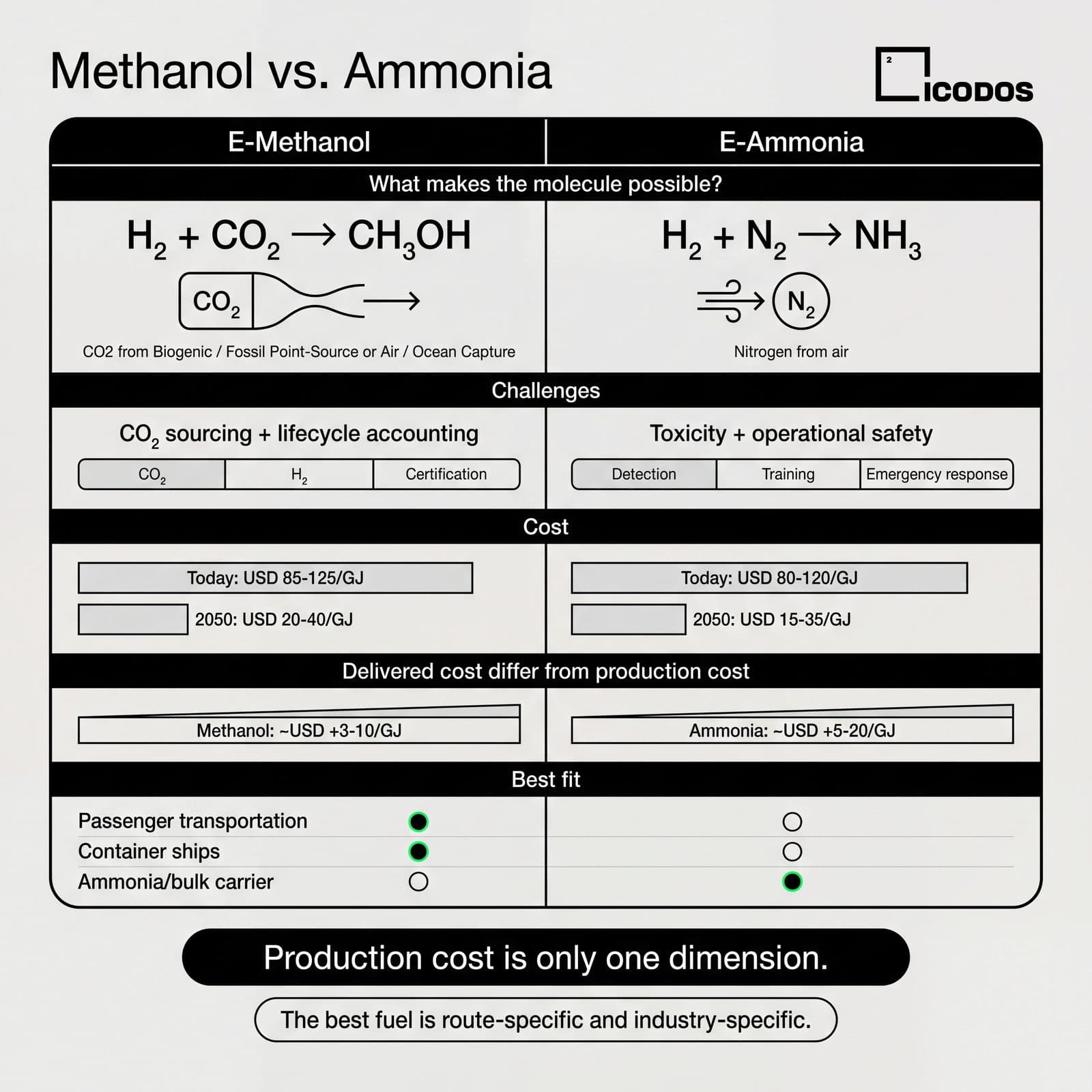
Shipping will not choose its future fuel in a spreadsheet. The spreadsheet matters — but the plant, the port, the ship, the crew and the customer decide what is actually usable. Comparing e-methanol and e-ammonia as shipping fuels, the interesting part is that they move the difficulty to different places.
Methanol makes the first system easier
Methanol is liquid at ambient conditions. Ports and chemical operators know how to handle it, and existing infrastructure can often be adapted. The market is already moving: roughly 60 methanol-capable ships are on the water, more than 300 are on order, and just under 20 ports already offer green methanol bunkering. The hard part is the carbon: e-methanol needs green hydrogen and credible CO₂. IRENA estimates current production at about $800–1,600/t with low-cost biogenic CO₂ or BECCS, and $1,200–2,400/t with DAC — roughly $40–121/GJ. By 2050, the range could fall to about $250–630/t, or $13–32/GJ. So the useful question is not whether ships can burn methanol — they can. It is where the carbon comes from, what it costs, and whether the lifecycle accounting survives regulation.
Ammonia makes the molecule cleaner
Ammonia needs nitrogen from air instead of CO₂ — that is powerful. IRENA estimates renewable ammonia at about $720/t today in the best locations, falling to about $480/t by 2030 and $310/t by 2050 — roughly $39, $26 and $17/GJ. The hard part is making ammonia ordinary: it is toxic, and needs stricter ship design, port procedures, detection, training, exclusion zones and emergency response. It also has to control NOx, ammonia slip and N₂O — a gas with 273 times the 100-year warming potential of CO₂.
Delivered cost is where it gets interesting
One RMI 2030 port case estimates delivered e-methanol at about $1,250/t and delivered e-ammonia at about $1,150/t. On an energy basis they are almost identical: around $63/GJ for methanol and $62/GJ for ammonia. That is the lesson: production cost is only one layer. The real system includes transport, storage, bunkering, vessel CAPEX, cargo-space loss, safety, insurance, regulation and customer willingness to pay.
The route-specific view
Methanol is the stronger early beachhead for container liners, fixed green corridors, short-sea shipping, ferries, RoPax and offshore support vessels. Ammonia is the stronger long-term candidate for ammonia carriers, gas carriers, large bulk carriers and ore corridors — if safety and N₂O are solved. The best fuel is route-specific before it is industry-wide.