
News
Unlocking the potential of sustainable biomethanol: BeBOP's second dissemination event in Brussels
UNI hosts the second major dissemination event of the EU-funded BeBOP project in Brussels, bridging innovation, industry and market needs through standardization, and launches the BeBOP Standardization Toolkit.
19 October 2026, UNI Ente Italiano di Normazione, Brussels, Belgium
On Monday 19 October, UNI (Ente Italiano di Normazione) will host a high-level stakeholder event in Brussels titled ‘Unlocking the potential of sustainable Biomethanol: Bridging Innovation, Industry and Market Needs through Standardization’.
Organized at the ENEA representative office, the event marks the second major dissemination event of the EU-funded BeBOP Project (Biomass to bio/E-methanol by Breakthrough SOEC-based Process: the BeBOP innovation, G. A. n. 101178117).
As Europe accelerates its transition towards a circular bioeconomy, the event will bring together key stakeholders from industry, research, policymaking, and certification bodies to explore the opportunities and challenges shaping the sustainable biomethanol sector. Discussions will focus on the current state of the market, emerging challenges and future prospects, highlighting the role of standardization in bridging the gap between innovative technologies and widespread commercial adoption.
The BeBOP Standardization Toolkit: a first-of-its-kind interactive resource
A central highlight of the day will be the official public launch of the BeBOP Standardization Toolkit, an interactive resource designed to make the standardization landscape more accessible to the general public, stakeholders, and researchers.
Developed using Microsoft Power BI, the Toolkit transforms complex standardization data into an intuitive, user-friendly digital resource. Its first Version 1.0 features 100 standardization references across 12 thematic areas, including biogas, biomethane, renewable fuels, Life Cycle Assessment (LCA), and the circular economy.
Equipped with advanced search and filtering functionalities, the Toolkit enables users to easily navigate the standardization landscape by keyword, technical committee, or development status. While providing links to official sources, such as UNI and ISO for full-text access, it offers industry professionals a practical reference tool to identify applicable standards and better navigate the European and global standardization framework.
This event will offer participants insights into emerging regulatory developments and evolving market needs for sustainable biomethanol. It will also provide a unique platform for dialogue and collaboration, enabling attendees to contribute to discussions that will help shape the future development of Europe's biomethanol value chain.
BeBOP project in numbers
Start date: 1 October 2024. Total project duration: 48 months. Total budget and EU contribution: € 11,166,415.71. 12 partners: EUCORE (Coordinator, Italy), Politecnico di Milano (Italy), LUT University (Finland), VTT (Finland), ELCOGEN (Estonia and Finland), ICODOS (Germany), ECODESIGN company GmbH (Austria), INERIS (France), WOOD (Italy), RIC (Poland), UNI Ente Italiano di Normazione (Italy).
The consortium
- EUCORE: BeBOP project Coordinator, leader of dissemination, communication and exploitation activities.
- Politecnico di Milano: the largest Italian technical university. Politecnico di Milano is the Scientific Coordinator of the Project in support of EUCORE, and it is responsible for the experimental testing of the electrolysis cell and the simulation of the integrated biomass-to-methanol plant.
- LUT University: the Finnish University responsible for modelling the digital twins of the BeBOP technology, assessing available biomass compatible with BeBOP technology, and analysing the policy framework for utilising different second-generation biomass sources.
- VTT: the Finnish independent research institute that hosts the pilot plant, which is currently being engineered and constructed, and integrated for gasifier, gas cleaning, solid oxide electrolyser, and methanol synthesis unit integration.
- ELCOGEN: composed of both its Finnish branch (ELCOY) and the Estonian one (ELCOGEN), the ELCOGEN group is responsible for the design and manufacturing of novel solid oxide cells incorporated into a new stack platform, designed for large-scale production.
- ICODOS: a German SME responsible for engineering and design of the methanol synthesis unit equipped with a 3D-printed reactor for integration in the pilot plant at VTT.
- ECODESIGN company GmbH: an Austrian engineering consultancy that assesses BeBOP's pilot plant and the bio/E-methanol production process in light of Circular Economy principles. Furthermore, the company conducts the LCA for the pilot plant and the scaled-up process to identify and quantify its key environmental aspects and impacts.
- INERIS: a French National Institute for Industrial Environment and Risks that contributes to the Project through industrial risk assessment and cost-benefit analysis of the BeBOP concept.
- WOOD: a global leader in consulting and engineering whose role is to develop the BeBOP scale-up, the pre-FEED study, and the economic analysis of a commercial-scale BeBOP plant, as well as supporting the exploitation of the project results.
- RIC: a Polish research and innovation center whose main role in the project is to develop methods for the recovery of valuable elements and compounds, primarily nutrients and (heavy) metals, from solid gasification residues.
- UNI: the Italian standardization body that is responsible for mapping existing standards and promoting the development of new pre-standardization documents.
Press release (PDF)
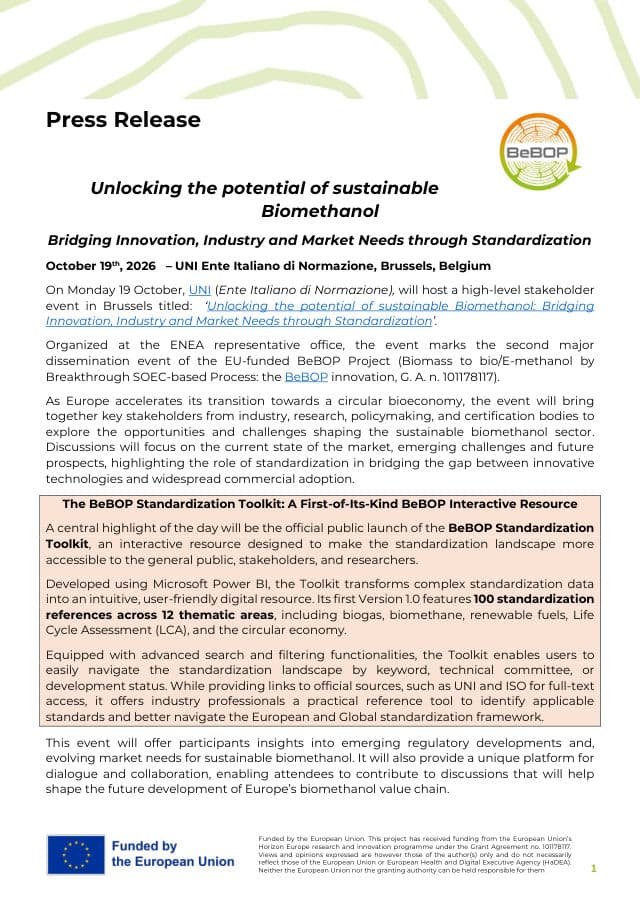
Press release: Unlocking the potential of sustainable Biomethanol: Bridging Innovation, Industry and Market Needs through Standardization
PDF · 2 pages · 0.3 MB · English · 19 October 2026
Funded by the European Union. This project has received funding from the European Union's Horizon Europe research and innovation programme under the Grant Agreement no. 101178117. Views and opinions expressed are however those of the author(s) only and do not necessarily reflect those of the European Union or European Health and Digital Executive Agency (HaDEA). Neither the European Union nor the granting authority can be held responsible for them.